


Nexxiot Launches Cargo Monitor for Supply Chain Transparency
Apr 6, 2022 at 3:30 PM
Logistikum Switzerland with ReThink Offer for Logistics
Apr 19, 2022 at 7:15 PM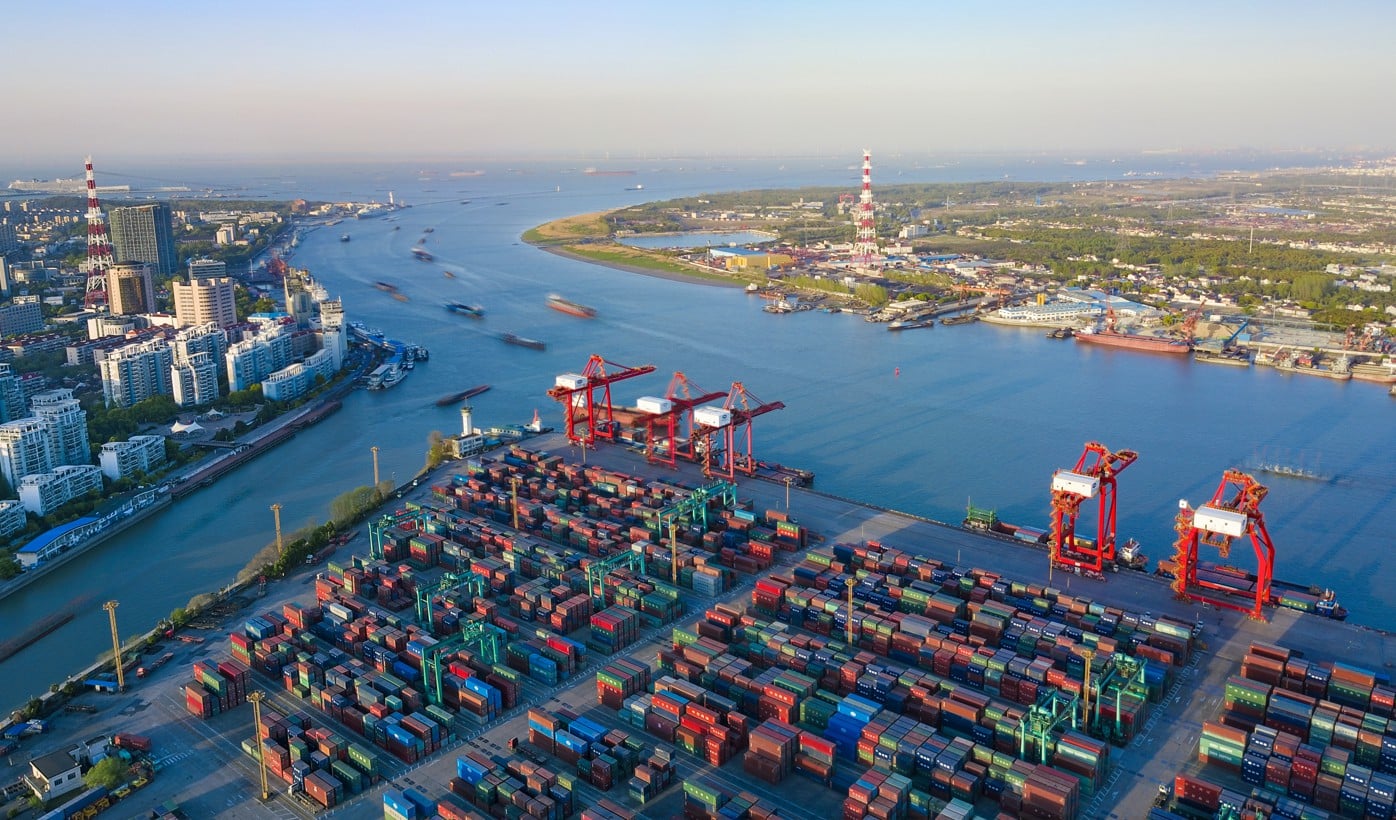
The French shipping company CMA CGM acquires the automotive logistics provider GEFCO and establishes its own cargo airline. The Danish shipping company A.P. Moller – Maersk also founds Maersk Air Cargo and has recently acquired the freight forwarders Senator in Germany and Pilot in the USA. The online giant Amazon launches the Amazon Freight Partner Program (AFP) and enters the sea and air freight business as Amazon Global Logistics. This is also in line with the news that the German discount supermarket Lidl intends to acquire its own container ships. The year 2021 delivered record revenues and profits for many freight participants. Part of this is now being invested.
(Basel) For decades, various freight forwarders (now referred to as logistics service providers) grew by largely forgoing their own assets. There were enough offers across all modes of transport, and one usually had the luxury of choice.
On the road, transport was entrusted to carriers or subcontractors. In air freight, shipments are entrusted to airlines. Sea freight is handed over to shipping companies, and rail freight to the railways or operators. Even in logistics real estate, specialists are relied upon to lease the corresponding spaces.
Of course, this cannot be generalized 100%. Particularly on the road, many freight forwarders have also invested in their own fleets or have acquired their own properties for handling and logistics. For many small freight forwarders, this is also part of the owners’ retirement capital.
Shipping companies and cargo airlines have been posting losses for years
The forgoing of assets had the following advantages for the respective logistics service providers:
- Low capital commitment
- No risk from seasonal fluctuations (freight)
- No risk of depreciation (real estate)
- Flexibility in market changes
In economically challenging times, the shipping companies, which are often criticized today, suffered greatly. Freight rates for sea transport on most routes, especially to and from the Far East (China), plummeted. However, the lines had to be maintained due to high import demand. The return shipments to the Far East primarily consisted of empty containers. Freight forwarders dictated the prices.
In air freight, airlines also experienced more bad times than good. The freight business was subject to significant volume and price fluctuations.
Freight railways rarely operate profitably. Individual intermodal operators are somewhat better off, especially those that also offer services in inland shipping or other container services (e.g., depots).
The road transport sector is also somewhat unique. Here too, there are economically driven fluctuations. There are times when the transport operator is literally grateful for every kilo of freight, and then there are times when cargo space is scarce and extremely valuable, as experienced recently during the pandemic.
External influences disrupt the balance
However, it is not only an economic boom or downturn that disrupts the rhythm of freight but also external influences, as painfully learned during the pandemic. Currently, a massive COVID-19 lockdown is again taking place in the Shanghai region of China, which will severely impact supply chains.
The war in Ukraine and the concurrent economic blockade are also having an effect. On one hand, goods from these two countries are missing, such as the now-famous “wiring harnesses” for the automotive industry from Ukraine or steel for nails from Russia, which are now missing, for example, in the production of pallets, etc.
The war in Ukraine is also apparently depriving the Western European market of urgently needed truck drivers, which is another unforeseen event shaking the markets. However, a global economic crisis is now also looming. The effects of the COVID-19 measures are revealing the downside for the first time. Much was “covered up” in 2020/2021, which is now coming to light. Reports about the business year 2021 are dripping with new record revenues, profits, and throughput volumes. Is that possible?
Often, the pent-up demand in 2021 coincided with current business. This resulted in such large volumes that they even surpassed the pre-pandemic year of 2019. Is reality returning now? Or is the war in Ukraine truly to blame for everything? As long as it remains on Ukrainian soil and hopefully a solution can be found this year, the damage would be limited.
Shipping companies and retail chains are becoming freight forwarders

Maersk and CMA CGM also operate their own air freight fleets (© Maersk /© CMA CGM)
After several years of stagnation and a contraction in the industry, shipping companies are rising like a phoenix from the ashes. Hardly a week goes by without news of new activities from a shipping company. In particular, the Danes from Maersk and the French from CMA CGM are making significant efforts.
Where it was once a disadvantage to maintain capital-intensive infrastructure, such as ships or containers, since 2020 it has become an advantage that allows revenues to flow in so quickly that one can hardly keep up.
And these cash inflows are also being heavily reinvested. Although shipping companies had already expanded their activities before the pandemic, investments were primarily focused on strengthening core business, such as establishing their own hinterland connections in the form of rail links from seaports to major economic centers.
Now, however, shipping companies are increasingly expanding services for their direct customers. In addition to the aforementioned own hinterland connections, shipping companies are increasingly booking space directly on the trains of intermodal operators and are also overseeing the trucking of containers to their destination stations. Freight forwarders as customers often find themselves in a difficult position, especially the smaller ones. Particularly in the current situation, shipping companies often allocate space on their ships only if they also handle the pre- and post-haulage themselves. This puts freight forwarders under significant pressure, as it was only in pre- and post-haulage that they could still earn something from sea freight, at least in the FCL (Full Container Load) business.
Shipping companies like CMA CGM and Maersk have now also entered the air freight business and established their own air freight companies. While this is not entirely new, it has been significantly intensified and will lead to a price war over air freight rates in tougher times.
The increased activities of shipping companies in acquiring freight forwarders are also noteworthy. Here, too, the line operators are broadening their scope. Door-to-door is transforming from a buzzword into an effective offering from their own hands.
Retail corporations are also entering the transport business
The online giant Amazon is increasingly becoming a logistics service provider. Its own aircraft, delivery vehicles, and logistics centers are available worldwide. What could be more natural than offering these capacities to third parties, especially merchants who are already using Amazon’s platforms for sales? This seems obvious, although the dependency on the large corporation is likely to increase.
The discount supermarket Lidl also plans to conduct transport to and from the Far East with its own ships in the future. Those who can demonstrate their own basic quantities can take such a risk. This will certainly make the discount retailer’s own supply chain more predictable.
 The container liner “TALASSA” will soon sail under the flag of Lidl
Threats to established logistics service providers?
What does this mean for established logistics service providers? Does this threaten their existence in the medium to long term? The example of booking only in conjunction with pre- and post-haulage services already indicates that a threatening path is being taken.
There are still thousands of medium and smaller freight forwarders in Europe that have a legitimate reason to exist. They occupy a valuable position. They are flexible and close to (small and medium) customers. However, one reads almost daily about some takeover of a transport company or a freight forwarder. On one hand, successors are often lacking, and on the other hand, many new regulations are forcing some businesses to close or sell.
The boom during the pandemic cannot disguise this, as even a week of war in Ukraine and the resulting price increases at gas stations have put some businesses in jeopardy. The battle for freight and warehousing services will continue. It seems that the times of overcapacity are approaching again.
Digitalization and driver shortages are indeed a burden for some businesses, but these are challenges that an established freight forwarding and transport company can manage. The industry has learned to cope with this, and the playing field is relatively level for both large and small players.
There are also challenges regarding sustainability, autonomous driving, or robotics in intralogistics. Retrofitting an entire fleet from combustion engines to electric vehicles is costly. Not only for the vehicles themselves but also for the entire infrastructure. Some funding programs help only to a limited extent. Retrofitting intralogistics also incurs significant costs.
The danger for established companies in the industry certainly exists. They must learn to compete with new competitors, who are particularly financially strong, emerging from the ranks of shipping companies. Buying a few freight forwarders or aircraft is not a problem. Financially robust digital freight forwarders are also continually emerging.
Smaller and medium-sized freight forwarders, who are facing a generational change in ownership and management in the foreseeable future, will think carefully about offering their companies for sale. As long as business is booming, this is certainly easier than in times of crisis. It is certain that there will be several more or less sensational transactions.
What lies ahead?
Unfortunately, there is no breathing space after the pandemic. Firstly, the pandemic continues to affect logistics chains, as seen in the situation in Shanghai. And in the fall, some politicians will want to revive COVID-19 and implement measures. However, there are many service providers who welcome this, as the distribution of vaccines, test kits, or disinfectants has provided some with two “fat” years. Initially, there were also special flights with masks, protective clothing, etc., which also brought in significant revenue.
The war in Ukraine could lead to a genuine economic crisis affecting the world and thus the logistics industry.
Together with the aforementioned other factors, a lot is coming up for the logistics service provider industry in the near future. There is no one-size-fits-all solution. Various influences need to be monitored. The freight volume is there. The pie will sometimes be larger and sometimes smaller. This has always been the case.
Only the players who want to feed on the pie are more diverse than ever, and this must be taken into account. This applies to both large and small freight forwarders.
Photo: © Loginfo24/Adobe Stock / Caption: The port of Shanghai is currently causing headaches along the supply chains