


Migros, Schindler, and LOXO Test Autonomous Delivery Service
Feb 9, 2023 at 5:10 PM
DB Schenker and MSC Launch Extensive Use of Biofuel
Feb 16, 2023 at 5:00 PM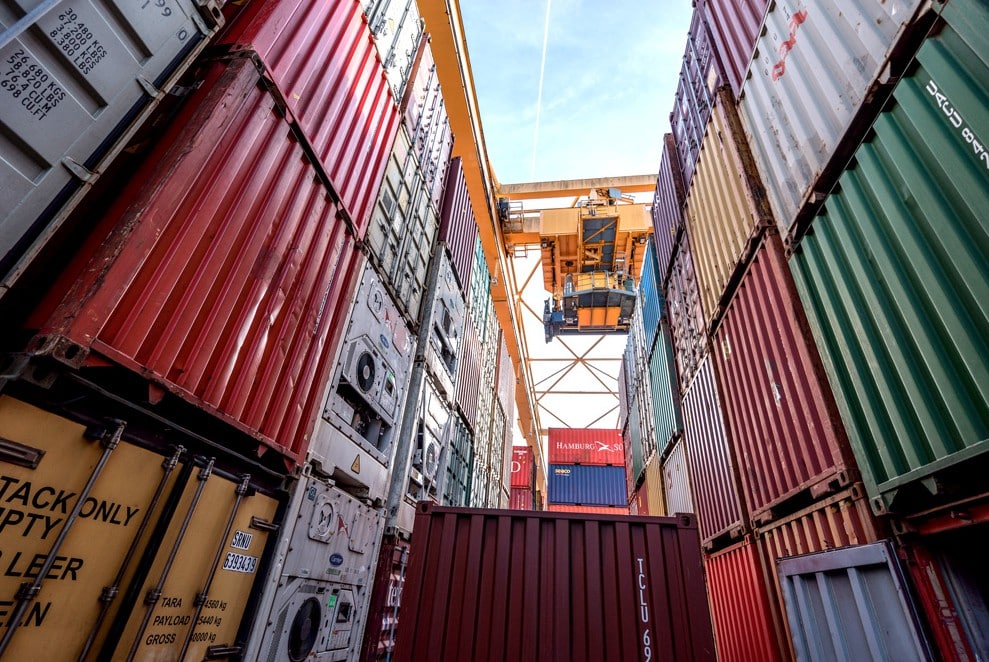
The container handling in the Swiss Rhine ports (SRH) showed results comparable to the previous year in 2022. However, the total port throughput is almost 15% below the previous year’s result, primarily due to the significant decline in the import of mineral oil products (-29%). The impacts of the Ukraine war, with its global market disruptions in the energy sector, were largely responsible for this outcome. These influences were exacerbated by the pronounced low water period in the summer. Fortunately, the container sector was able to handle the high demand in the first half of the year, finishing at a stable level.
(Basel) 4.60 million tons were handled in the Swiss Rhine ports in 2022. In 2021, it was 5.41 million. Comparing the individual monthly results clearly shows the external influences and their effects. January 2022 had an overall throughput that was still 7% above the corresponding month of the previous year, while February was nearly on par. This can be attributed to catch-up traffic following a low water period at the end of 2021. The Ukraine war, leading to shortages and rising prices of energy and agricultural products, had an impact as early as March, resulting in a decrease of 26% compared to the corresponding month of the previous year, and this effect significantly increased over the course of the year.
In the summer, low water conditions added to the unfavorable circumstances, leading to more than a halving of the monthly throughput in August (-58% compared to August 2021). The last quarter, with improved water levels, again led to catch-up traffic and strong monthly results in October (+29%) and November (+32%). However, this was not enough to reverse the negative trend from the previous quarters.
Looking at the individual ports, the port of Muttenz-Au, heavily dependent on the development of mineral oil traffic, was the most affected with 1.31 million tons (-23.9%), but the port of Birsfelden with 1.56 million tons (-17.0%) also could not escape the negative developments. Without the influences of the energy sector, the port of Kleinhüningen, with a total throughput of 1.45 million tons (-2.4%), remained almost at the previous year’s level. The import or upstream traffic in all three ports – with nearly 3.73 million tons the clearly more important of the two sectors – fell by almost 17% compared to the previous year, while the export or downstream traffic with 878,000 tons decreased by nearly 5.0%.
In container traffic, 125,470 TEU were handled at the Rhine port terminals, which is only slightly below the total of the previous year. The low throughput results in the summer (low water) were nearly compensated by the strong first half of the year and catch-up traffic in late autumn. However, since September, the handling capacities have been reduced due to the cessation of terminal operations at the South Quay. The container crane of Contargo AG had reached the end of its life cycle, was dismantled, and is to be replaced by a new crane at the North Quay. However, for this swap, a new hall must first be built at the South Quay to replace the old “Satram Hall” at the North Quay. Until the new container crane at the North Quay is operational, container handling will be partially carried out at the container terminal of the port of Weil am Rhein, which has also been operated by Contargo since August 2021.
Container Traffic
A total of 125,470 TEU were handled in the reporting year, which corresponds to a nearly unchanged value (-0.45%) compared to the previous year (126,042 TEU). The months of February (+62%) and March (+22.6%) saw particularly strong growth. In August (-34.4%) and September (-17.9%), this sector also had to pay the price for unfavorable water levels.
The overall decline is focused on the traffic with empty containers; this serves to balance the depots between sea and inland ports. A total of 37,430 empty containers were moved in 2022, 6.1% less than in the previous year. The incoming traffic decreased by 21,035 TEU or -18%. The amount of outgoing empty containers increased by 15.1% to 16,395 TEU.
In 2022, a total of 88,039 TEU of full containers were handled, which represents an increase of 2.1% compared to the 86,196 TEU. The “pure” import traffic (full containers) rose by 6% compared to 2021, totaling 45,977 TEU. In contrast, the “pure” export traffic (outgoing full containers) had to register a decrease of nearly 2% to a total of 42,063 TEU.
A special factor to consider is the handling at the Kesslergrube from May to December 2021 (a remediation project by Roche AG in Grenzach-Wyhlen), which had extraordinarily increased the total of the comparison year 2021. In total, nearly 4,000 TEU (import and export) were handled, accounting for about 3.1% of the container throughput. Without these special transports, the container throughput in 2022 would even be above that of the comparison year.
The container shipping in 2022 was also heavily influenced by the lack of sufficient ship capacities. This was triggered by the high demand for shipping space for coal transport for German power plants and the transport of grain from Ukraine on the Danube. The availability of necessary ship personnel was also severely restricted, leading to significant problems in the schedules for all shipping companies. Additionally, there remained significant planning uncertainty due to existing processing issues in the inland shipping sector at the seaports of Rotterdam and Antwerp.
In conclusion, it is noteworthy that inland shipping was able to achieve the previous year’s result in 2022 despite unfavorable circumstances – and this was one of the best results in long-term comparison for container handling by ship in the Rhine ports.
Liquid Fuels
In 2022, 1.66 million tons of liquid fuels were imported through the Swiss Rhine ports. Compared to the throughput of 2.33 million tons in the previous year, this represents a significant decrease of 29%. In the first three quarters of the reporting year, a strongly negative development of -46% was recorded. The fourth quarter saw an improvement but no real trend reversal.
The cause lay in the massive price increase for mineral oil products in connection with the war in Ukraine. The import was therefore limited to a minimum, and stocks were significantly reduced. In the third quarter, low water conditions further compounded the situation. Ships that would normally dock with loads of 3,000 tons in Muttenz and Birsfelden could only be loaded with 500 to 900 tons.
The only remaining refinery in the country benefited from this development and was operating at high capacity. The removal of heavy oil as a residual product occurs by ship; here, the throughput increased by over 54% to around 54,000 tons.
In the fourth quarter, imports began to grow again due to falling prices in the energy market for refined mineral oil products, with increased stock replenishment occurring.
The main products in this sector exemplify the development. The group of gas, diesel oil, and light heating oil fell from 1.83 million tons to 1.26 million tons, a decrease of no less than 31%. In the segment of motor gasoline and other light oils, throughput decreased from 490,000 to 415,000 tons, a drop of 15%.
In 2022, the share of Rhine shipping in import traffic remained unchanged at 52% compared to the previous year. Rhine shipping and the Rhine ports will continue to ensure the national supply in the energy sector.
Agricultural Products / Food and Feed
Low customs rates and falling raw material prices were responsible for an increase in quantities in the groups of agricultural products as well as food and feed in the fourth quarter, allowing for a normal quarter in terms of volume. Compared to the previous year, the fourth quarter overall improved by 15% or 24,500 tons, with the previous year being recorded as a rather weak import year. Overall, the year 2022 was concluded with a slight increase of around 2.5% or 17,400 tons compared to the previous year.
Agricultural products recorded an increase of almost 63% in the fourth quarter compared to the previous year, corresponding to a volume of 32,000 tons. In this area, the declining raw material prices in conjunction with low customs rates were particularly noticeable.
In the segment of food and feed, a total of 101,414 tons were handled in the fourth quarter, representing a slight decline of 6.8% compared to the previous year. In December, there was an increase compared to the previous year, as quantities affected by delays arrived in Basel.
The recovery of raw material prices is currently ongoing, so increased imports into Switzerland can also be expected in January 2023.
Other Goods
Seasonally, the activities of the construction industry and thus the imports and exports of the product group stones, earth, and building materials decrease during the winter. However, due to the very low imports of only 24,765 tons in December 2022, even less than the weak import quantities caused by low water in August 2022, nearly 25% or 35,275 tons fewer building materials were imported in the fourth quarter of 2022 than in the fourth quarter of the previous year. In contrast to imports, exports of building materials in the fourth quarter of 2022, thanks to very favorable water levels, were more than 18,000 tons larger than the quarterly average, totaling 79,498 tons.
This again shows how important stable freight prices and water levels are for this product group. High price fluctuations immediately lead to declines in the handled quantities and cannot be quickly compensated. From a global perspective, the high energy and freight costs, as well as the low water levels in the summer of 2022, resulted in a decrease in import volumes of 15% or 104,421 tons and exports of 19% or 58,154 tons compared to 2021.
In 2022, global demand for high-quality products “Made in Switzerland” from iron, steel, and non-ferrous metals was confirmed, albeit partially at a lower level. In the fourth quarter of 2022, imports of goods such as steel semi-finished products, steel sheets, or aluminum amounted to 54,520 tons. This represents a clear decline compared to the other quarters with average imports of 64,666 tons. However, year-on-year, imports were slightly higher by 4.8% or 11,846 tons compared to the previous year. For the entire year, nearly 269,000 tons were handled, representing a decrease of 12.3% (37,651 tons). Goods from the product group of iron and steel and non-ferrous metals continue to be exported primarily by container. This product group can therefore be used as an indicator of the success of the steel and aluminum processing industry.
Fewer exports but more imports characterize the area of chemical products. Import traffic in this sector rose by 14% to nearly 154,000 tons compared to the previous year’s figure (135,020 tons). In contrast, export traffic fell by 26% to nearly 40,000 tons. Since Swiss chemistry primarily imports raw materials and processes them into finished products, it can be concluded from this development that companies in this sector had to replenish their stocks with raw materials.
Photo: © Port of Switzerland