


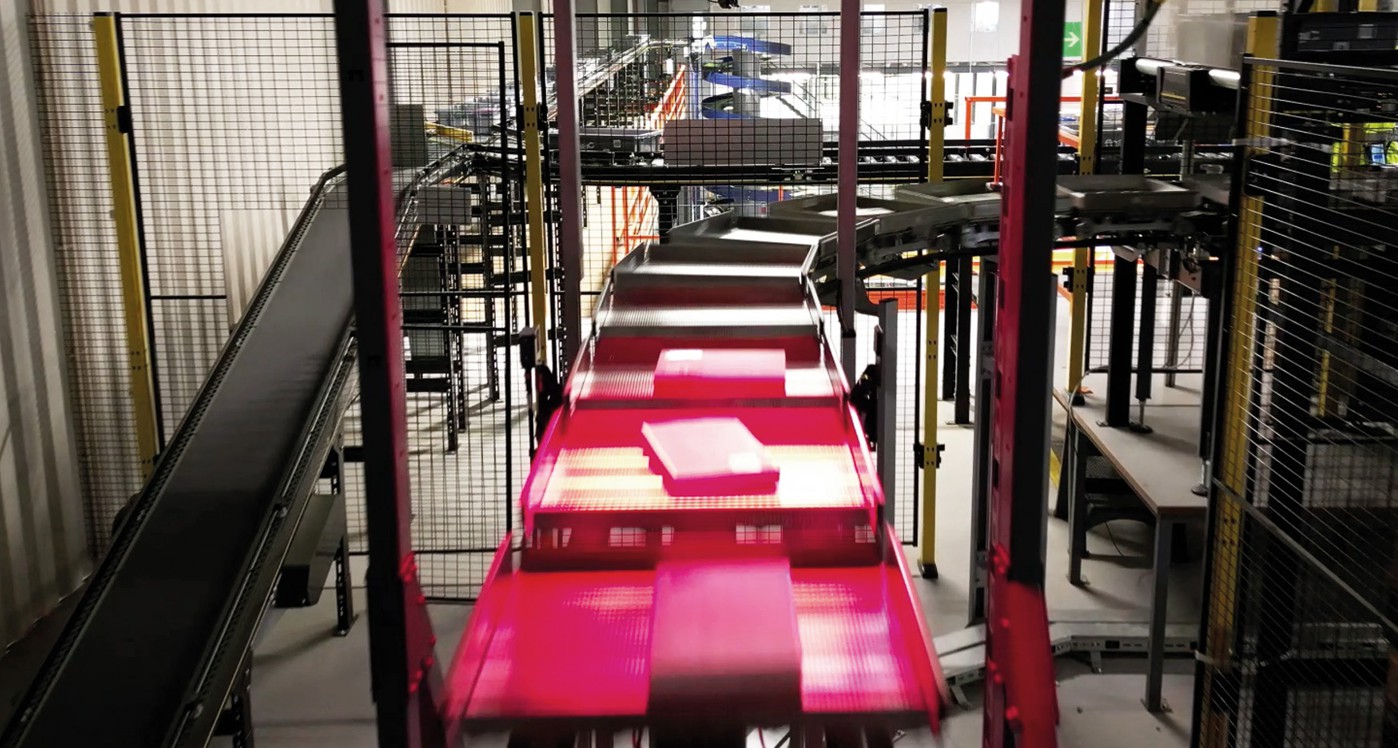
Ferag implements omnichannel distribution center for fnac in Lisbon
Feb 18, 2025 at 5:53 PM
Logistics Market Study Switzerland 1/25 by GS1 is online
Mar 4, 2025 at 6:26 PM
This guest article addresses the complex topic of quantum computing and an application example from logistics. Rainer A. Stawarz, founder and CEO of K&S Informatik, which specializes in customs solutions based in Zurich, attempts to illustrate what is possible with a suitable quantum algorithm using simple terms, exemplified by the assignment of containers to storage spaces in port terminals.
By: Rainer A. Stawarz
(Zurich) This article discusses a problem that can occur in container ports: the efficient allocation of storage spaces for incoming containers. It is not only important to find an available space but also to consider the cargo of the surrounding containers. This is particularly relevant to avoid accidents like the severe explosion in the port of Tianjin in 2015.
The Problem at a Glance
Imagine a large container ship, such as the “Sovereign Maersk,” arriving at a port, here exemplified by Shanghai, and needing to unload 7,500 containers. The port system now has the task of finding and reserving a suitable storage space for each of these containers.
In the world’s largest container port in Shanghai, over 47 million standard containers (TEU) were handled in 2023. This means that thousands of containers need to be re-stacked and unloaded daily. An efficient system for managing storage spaces is therefore essential.
Challenges of the Classical Method
In conventional methods, each possible storage space is checked individually. Even if each check takes only a tiny fraction of a second, the computation time can add up to several hours when dealing with thousands of storage spaces and containers. While there are optimizations in practice, such as grouping similar containers or excluding certain areas from the search, bottlenecks can still occur—especially when legal regulations for hazardous materials, fire protection, or safety distances are further tightened. In such cases, computation time quickly becomes a critical factor.
The Quantum Approach as a Solution
Here, quantum computing could offer a solution. In 1996, Indian mathematician Lov Grover developed a quantum algorithm that significantly speeds up database searches. Instead of searching all storage spaces individually, a quantum computer using this algorithm can conduct the search in significantly fewer steps. In our example with 40,000 possible storage spaces, the quantum algorithm would require only about 200 computation steps. This could reduce the total computation time from several hours to just a few minutes or even seconds—without compromising accuracy.
Practical Challenges and Outlook
However, one challenge remains: the evaluation of storage spaces is based on several criteria that can be summarized in a so-called “suitability vector.” A quantum computer, however, operates with qubits that cannot directly handle such complex data structures. Therefore, the algorithm would need to be adjusted to process the individual evaluation criteria separately. While this might slow down the computation somewhat, the method would still be significantly faster than conventional systems.
Microsoft is Close with the “Majoran 1” Project
In summary, this article illustrates how quantum computers could revolutionize logistics in container ports—provided that the theoretical concepts can be implemented in practice. Current developments, such as Microsoft’s “Majoran 1” project, raise hopes that such quantum algorithms could soon become a reality.
Rainer A. Stawarz is the founder and CEO of K&S Informatik. He studied nuclear energy systems and theoretical computer science.
Title image: © Loginfo24