

REGA founder in the Swiss Supply Chain Hall of Fame
May 19, 2025 at 3:50 PM
MBS Logistics acquires Gerhard Wegmüller GmbH in Zurich
May 22, 2025 at 7:22 AM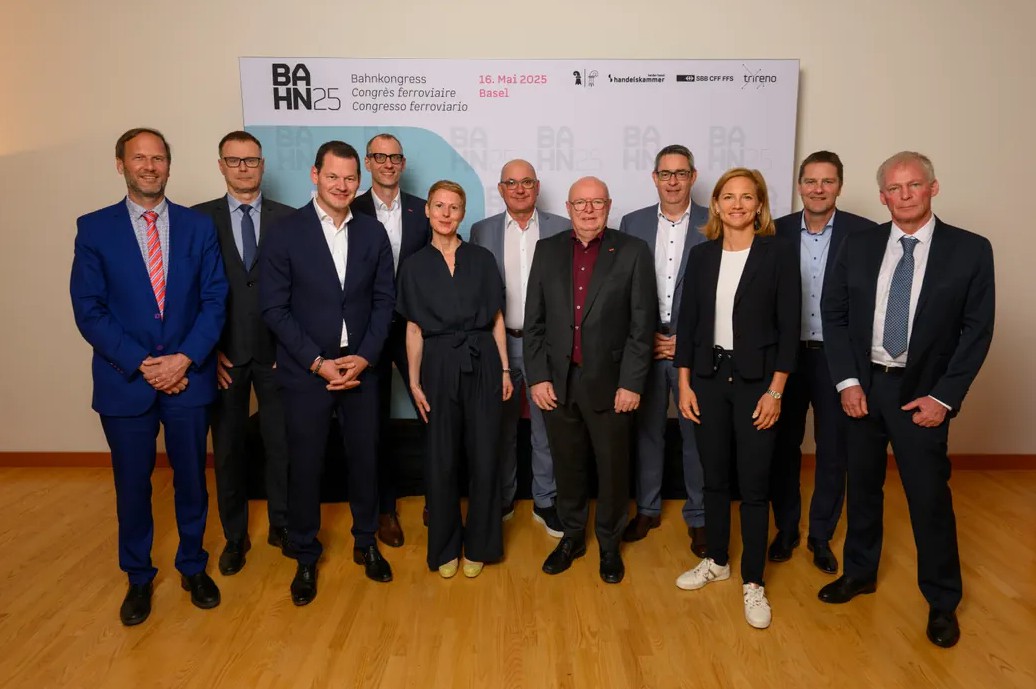
As part of the railway conference Bahn25 titled “Advancing Rail Freight Transport Together,” high-ranking representatives from politics in Switzerland, Germany, and the EU, from chambers of commerce, major logistics companies, and the shipping industry met last Friday in Basel before a large audience. The inconclusive conclusion was: “Only together can we succeed.”
(Basel) The annual railway conference is gaining increasing influence and attracts hundreds of decision-makers from politics, the transport industry, and railway operators. This year, the focus was clearly on rail freight transport. High-ranking representatives from the federal administration and the national railway company, along with foreign representatives, discussed the challenges and perspectives of freight transport by rail with business representatives.
At the beginning of the event, Martin Dätwyler, Director of the Chamber of Commerce of both Basels, pointed out the outstanding role of the Basel region for export, import, and transit traffic – and warned against jeopardizing this role through insufficient investments. The expansion of infrastructure is therefore essential – especially the repeatedly delayed trimodal terminal “Gateway Basel Nord.” For the sake of completeness, it should be mentioned that more and more logistics companies are disappearing from the region. It would be easier to maintain existing areas than to create new ones in the densely populated region. The railways also play a role here by converting former freight areas into residential areas, which generates more revenue than logistics areas.
Four Core Demands for Increased Efficiency
At the conference, the cantons of Basel-Stadt, Basel-Landschaft, Geneva, Ticino, and Valais adopted a resolution with four central demands: First, better connectivity of border areas to regional transport; second, strengthening strategic freight transport corridors, particularly in the south and west, as well as in the two Basels. Third, secure, long-term financing through the railway infrastructure fund is demanded. And fourth, prioritization of investments in particularly burdened railway junctions.
Delays and Closures Burden the System
However, not only is the European rail freight transport currently in a difficult situation. Massive construction projects and bottlenecks in neighboring countries lead to an alarming punctuality rate: Only a fraction of freight trains currently reach their destinations on time. Jörg Stefan, Head of Rail Freight Transport at the German Federal Ministry of Transport, even stated that the journey to the conference felt like a trip to the gallows given the current situation.
There were also some pointed remarks, particularly against Deutsche Bahn, as the problems there have repercussions for neighboring countries, especially Switzerland and Austria. A clear statement was made by Sven Flore, CEO of SBB Cargo International. He criticized that while there is always a call for more money for infrastructure, obvious issues like personnel problems are hardly addressed. There is significant potential for improvement in personnel efficiency in the short term. Bureaucracy also plays a significant role.
Martin Brunner, Managing Director of DSV Switzerland, was also critical of the railways. He mentioned that while it would help if the railways were more proactive in informing about delays and problems, the best solution for the customer must be found, which often lies on the road.
In another presentation, Ulla Kämpf, introduced as an expert in rail freight transport, passionately argued that freight transport by rail must be rethought, approached differently, and that there must be the courage to abandon previous patterns, without, however, becoming specific. When moderator Dieter Kohler asked how she would approach changes, there was – nothing.
Abolition of the Rolling Road
The abolition of the “Rolling Highway RoLa” by the end of 2025 (instead of the end of 2028) by Switzerland was also mentioned. Due to the already outlined problems, the implementation became even more challenging than it already was. It was a loss-making venture in any case. However, the RoLa removed 80,000 truck trips from the road, and it can be safely assumed that these will now return to the road. Establishing traffic in unaccompanied combined transport as an alternative is hardly possible, as it requires significant volume and a reasonably balanced parity in traffic flows. The customers of the RoLa cannot fulfill this, which is why they chose this route over the Alps.
Conclusion
The large and leading railways are still the former state railways. They are generally public law companies. Their organization is usually linked to the infrastructure, albeit with their own subsidiaries, but still not entirely independent. The appointments to supervisory and management bodies are primarily or often based on political desires or sensitivities. And with the cumbersome subsidiaries in freight transport, little glory can be achieved.
Private railways demonstrate that freight transport by rail can also be successfully implemented. However, they also face obstacles, such as rising track prices, construction sites, or the absence of signal box staff, etc.
At the conference in Basel, the majority of participants were representatives from politics, business associations (often also politicians), and representatives from economic sectors that rely on the railway. Among the logistics service providers, two industry leaders, DSV and Rhenus, were present, who have sufficient volume on the main routes to handle this by rail.
It can be assumed that what fits on the rail is already running on the rail, not for ecological but for economic reasons. Industries with bulk goods, such as steel, mineral oils, liquid chemicals, cement, etc., rely on the railway, particularly on a functioning one.
All hinterland traffic with seaports is also running intermodally on the rail or, where possible, on water.
The road could not compete in these cases, neither organizationally nor in terms of price.
In this light, there were approaches at the congress to improve what exists. However, the time horizons are, by nature, more to be measured in decades than in years. Whether the large railways, in addition to investments in infrastructure, are also willing to question their internal organizations remains open.
Photo: © Bahn25 / Caption: They spoke at the railway congress in Basel (l. to r.): Jörg Stefan, Head of Rail Freight Transport, Federal Ministry of Transport Germany / Prof. Pawel Wojciechowski, EU Coordinator North Sea-Rhine-Mediterranean Corridor / Pierre Maudet, State Councilor of the Canton of Geneva / Alexander Muhm, Head of Freight Transport SBB AG / Christa Hostettler, Director of the Federal Office of Transport / Isaac Reber, Government President Basel-Landschaft / Vincent Ducrot, CEO SBB AG / Martin Dätwyler, Director of the Chamber of Commerce of both Basels / Esther Keller, Government Councilor Basel-Stadt / Stefan Luggen, Deputy Head of Mobility Canton Valais / Claudio Zali, State Councilor Ticino