


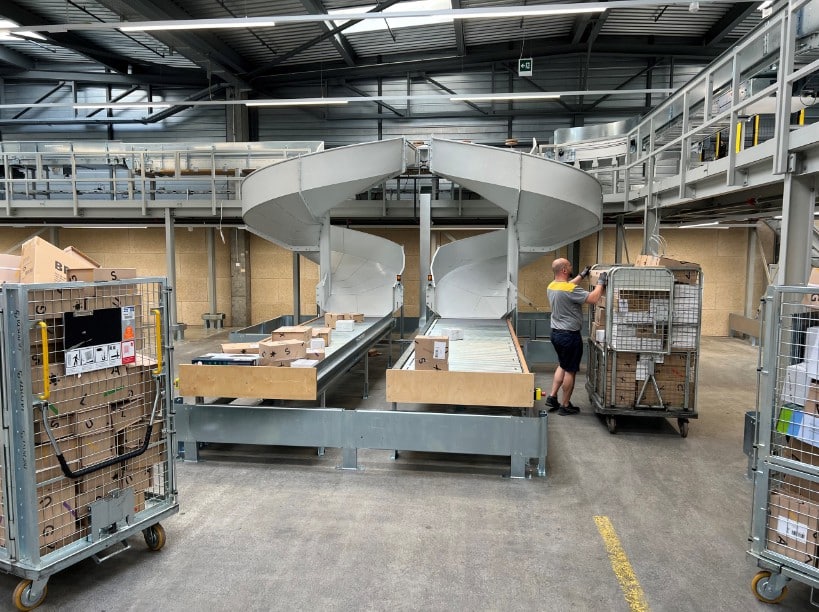
Swiss Post presents its new parcel center in Buchs
Aug 28, 2022 at 12:55 PM
Sarah Kreienbühl succeeds Lothar Harings at Kühne+Nagel
Aug 30, 2022 at 5:46 PM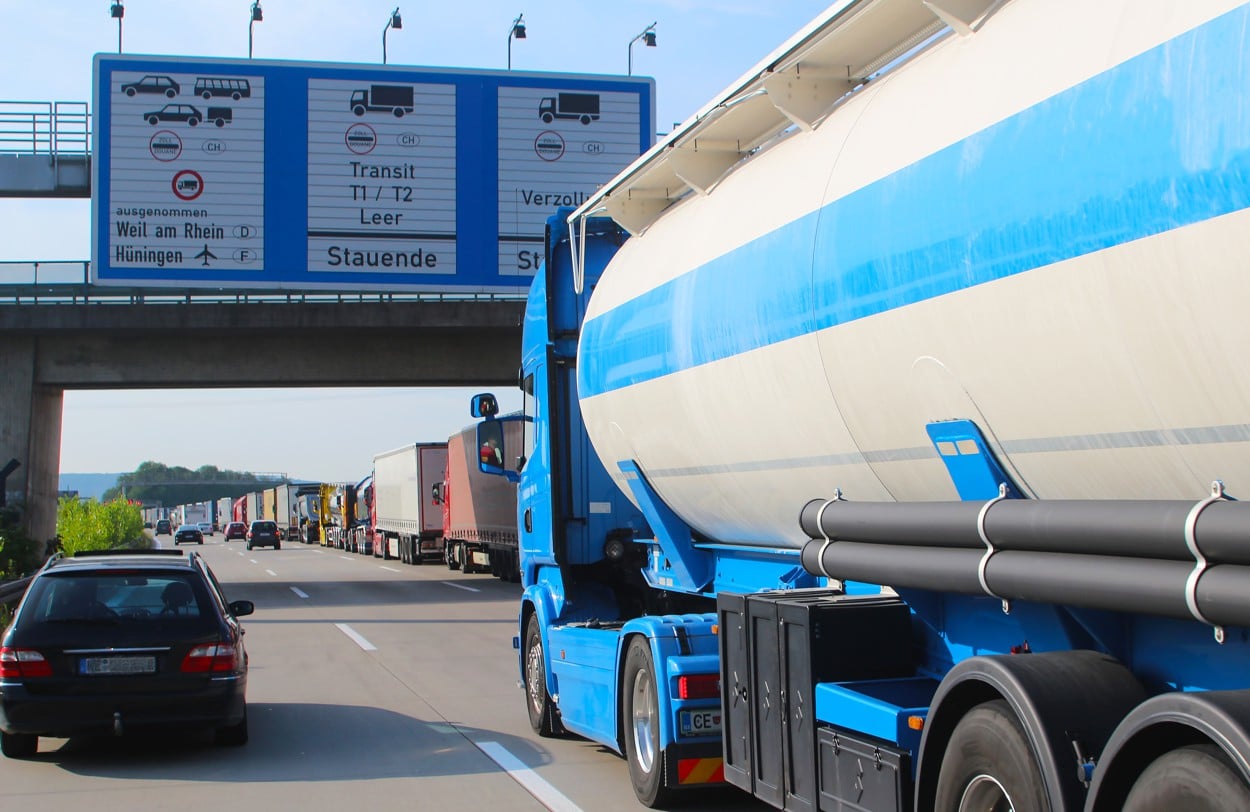
The customs clearance process at the Swiss customs is on the verge of a transformation. Today’s IT applications date back to the 1990s and should have been replaced long ago. However, an end to this situation now seems to be in sight. From 2023 to 2025, the goods traffic system Passar is to be installed as part of the DaziT program (Modernization and Digitalization of the Federal Customs Administration). Karl Strohhammer from ZFEB GmbH – Customs & Trade Consultants provides an overview of the development and perspectives.
By Karl Strohhammer
Background
The central ICT applications of customs date back to the 1990s. This primarily includes the electronic clearance systems EDEC. They are thus in the final phase of their lifecycle. Between 2010 and 2015, the administration commissioned several studies. However, it soon became clear that cross-application improvements could not be realized or only partially achieved. Only the results of the study “GAR-EZV – Business Principles, IT Architecture, and Roadmap” pointed in the right direction. With its holistic view, this study formed the basis for the Federal Council’s message of February 15, 2017, regarding the financing of the modernization and digitalization of the Federal Customs Administration (DaziT program). “DaziT” stands for “Dazi,” the Romansh word for customs, and “Transformation.” There was little discussion. On September 12, 2017, the Federal Assembly approved the requested total credit of 393 million Swiss francs for the realization of this project. The official launch for implementation took place in January 2018.
The first pillar: Simplification and digitalization of processes
In the first four years, around 20 apps, applications, and IT base services were put into operation. These affect both private individuals (e.g., QuickZoll for customs clearance in travel) and businesses. Accompanying documents can now be transmitted electronically. It is also worth mentioning that master data is now maintained on a central platform (SAP MDG). Karl Strohhammer from the consulting firm
Goods traffic system Passar
This is the main application and thus the heart of DaziT. Currently, development work is in full swing. Passar will replace NCTS, e-dec (import and export), and e-dec web. As of now, the phased implementation is planned as follows:
- From August 2022, functionalities for Passar 1.0 (export, transit) will be developed.
- The transition phase for Passar 1.0 begins on July 1, 2023.
- Registration with NCTS is possible until October 30, 2023.
- The transition phase for e-dec export ends on June 30, 2024.
- The transition phase for Passar 2.0 (import; until June 30, 2025) starts on January 1, 2025.
By July 1, 2025, all previous electronic clearance systems for commercial goods should thus be renewed. By the project’s completion in 2026, all special cases (e.g., returned goods, exemptions, etc.) should also be covered.

The second pillar: Organizational development
The DaziT program was originally viewed primarily as an IT project. However, it soon became clear that alongside simplification and digitalization, another element gained importance: organizational development. According to a fundamental decision by the Federal Council on April 10, 2019, this includes, among other things:
- The six new directorates are called Operations, Risk Analysis and Analytics, Fundamentals, Law Enforcement, Support, and Planning and Control. The Operations directorate combines the previous units of customs and border guard and consists of six regions (regional level) and 23 local units (local level).
- The new professional profile “Customs and Border Security Specialist” combines the previous professions “Customs Specialist” and “Border Guard.” The specialists receive a common basic training for comprehensive inspections of goods, persons, and means of transport and subsequently specialize in at least one of these areas. The first course began in August 2021. Targeted training measures will be offered for existing staff starting in 2022, especially in the area of security. All operational personnel are uniformed (with protective vests and military ranks) and armed according to their tasks.
Since January 1, 2022, the former Federal Customs Administration (EZV) has been renamed the Federal Office for Customs and Border Security (BAZG).
Assessment and outlook
The goals of DaziT, especially the intended simplifications and digitalization, are largely undisputed. Nevertheless, the EZV or the BAZG has faced criticism from various quarters in recent years (financial control, trade unions, media, business associations). Numerous parliamentary inquiries and motions have also been raised. The most significant is certainly the report from the Audit Committee of the Council of States dated May 23, 2022. It questions the appropriateness of certain aspects of the reorganization from a political perspective (uniformity, arming, name change).

So far, the BAZG and the Federal Council have managed to deflect or ride out the criticism. Only in the coming years will it become clear whether the new customs processes are indeed simpler than before, as promised. The organizational and personnel measures must also prove themselves and gain political acceptance. The following questions arise:
- Can the costs for businesses and administration be actually reduced through simplification and digitalization as announced?
- The enforcement of so-called non-customs legal provisions (NZE; now non-tax legal provisions NAE) poses one of the major challenges in cross-border goods traffic. Will the improvements, as announced by the Federal Council in its report of September 13, 2019, be realized (fulfillment of Postulate 17.3361)?
- It is of no use if one can practically drive through the Swiss customs with a truck thanks to digital clearance but still has to stop for formalities at foreign customs offices. Is it ensured that the procedures at foreign border customs offices are also digitized simultaneously with Passar? Can the European Commission prevent or delay anything for political reasons?
- The BAZG places a strong emphasis on security and repression. This is evident not least in the prominent position of the new directorate for law enforcement as well as in the training, uniforming, and arming of operational personnel. Therefore, there is a fear that the competencies and services of the previous customs specialists, which are important for businesses, will gradually lose significance. How can this development be prevented?

Further aspects
New customs law
According to the BAZG, the complete revision of the customs law is part of the transformation. It is planned that the Federal Council will adopt the message for the new customs legislation after the summer holidays. The BAZG has announced that the drafts will take into account some of the concerns raised by the business community during the consultation:
- The goods provisions are defined again at the level of law. Data processing has also been completely revised according to new data protection guidelines.
- The deadline for objections and complaints will be uniformly set at one year.
- The formal strictness will be relaxed. Benefits can also be claimed within the framework of the supplementary assessment procedure.
- A customs advisory committee will be established analogous to the value-added tax.
It remains to be seen how Parliament will deal with the drafts from the Federal Council. There are significant doubts as to whether a complete revision of the legal foundations is truly necessary for DaziT.

Abolition of industrial tariffs
On October 1, 2021, the Federal Assembly approved a change to the customs tariff. This will largely abolish tariffs for chapters 25 to 97. Additionally, the structure will be simplified with the elimination of around 1800 tariff lines. The change will come into effect on January 1, 2024. Due to the lack of coordination with the DaziT timeline (especially Passar), both administration and businesses must expect a higher effort for implementation.
Karl Strohhammer is a customs law expert and customs consultant at ZFEB GmbH – Customs & Trade Consultants. He possesses unique, in-depth, and broad knowledge in the field of customs tariff and customs law. Karl Strohhammer worked at the customs administration from 1974 to 2018, including since 1983 in Bern as a customs expert and section head of the Federal Customs Directorate.
His demanding responsibilities included public customs tariff decisions, non-customs legal provisions, and participation in legislative processes. His training activities within and outside the administration are also noteworthy.
Today, he supports internationally active Swiss companies as a customs consultant from Zollschule.ch with customs law questions and customs procedures, tariff classification, or product clarifications abroad. https://zollschule.ch/