




Birsterminal ships warm press to Antwerp
Jul 2, 2026 at 11:15 AM
Planzer expands Kyburz fleet for logistics training
Jul 3, 2026 at 1:31 PM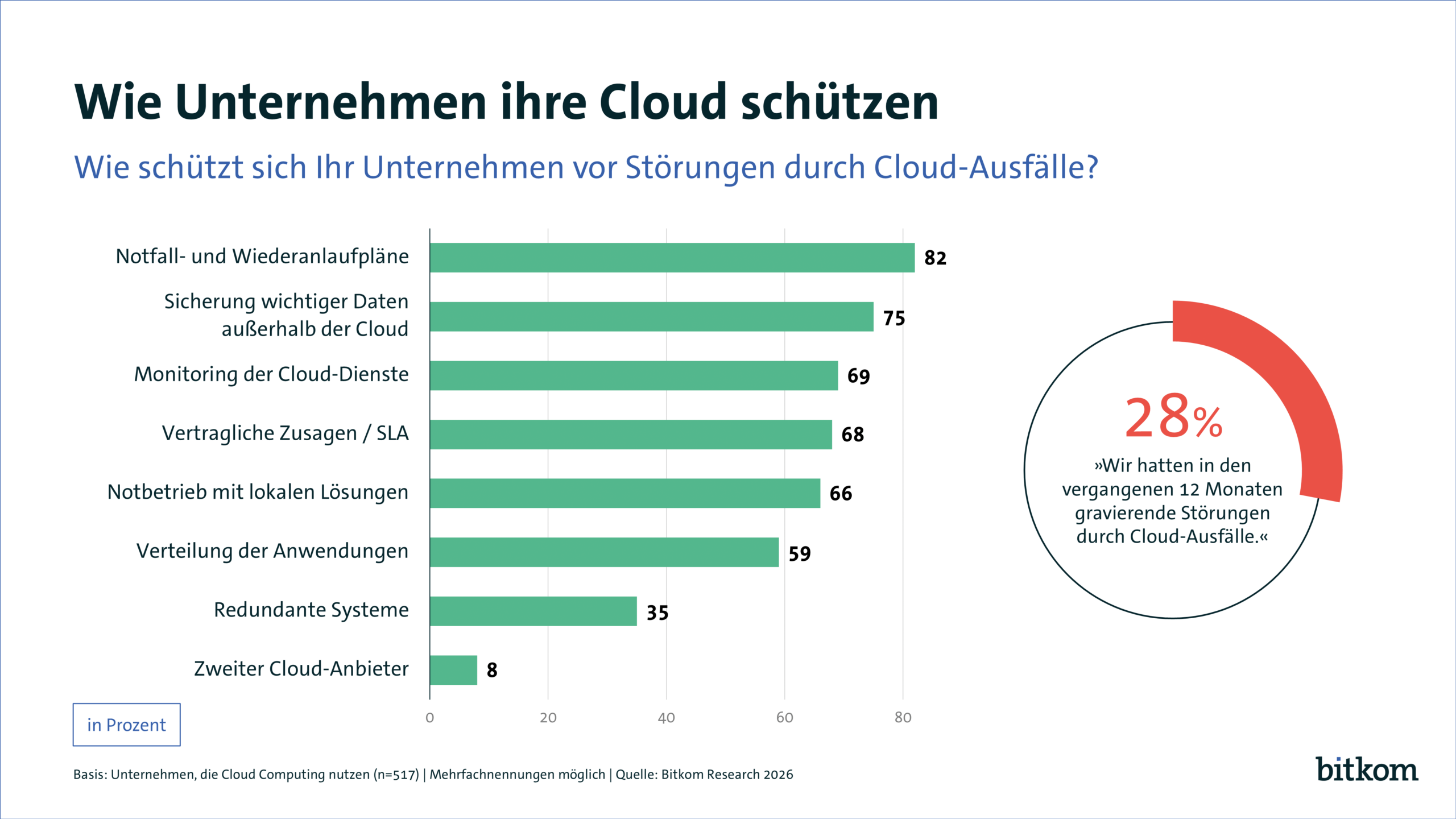
Internet disruptions, power outages, or issues with software updates can have significant consequences for businesses in Germany. A recent survey by the digital association Bitkom shows that nearly half of the surveyed companies (46 percent) would be forced to halt operations in the event of a cloud outage. Nine percent of companies stated that they would be unable to continue working at the moment of an outage. The survey, which included 603 companies with at least 20 employees, also revealed that 2 percent of respondents expect to manage without cloud services for 6 to 11 hours, while 4 percent expect 12 to 24 hours and 10 percent 24 to 48 hours. One-fifth (21 percent) of companies even anticipate downtime of more than 48 hours.
A quarter of the companies (24 percent) would not be affected by a cloud outage to the extent that they would need to cease operations. Fourteen percent of respondents do not use cloud services, while 16 percent did not want or could not provide information on this. On average, cloud users estimate that they could continue working for about three days (78 hours) without cloud services.
Cloud Services as Essential Infrastructure
“A functional cloud is as important for businesses as stable power supply and access to the internet. Office software, communication, databases, or even AI solutions are unavailable during a cloud disruption, yet they are essential for the operations of many companies,” explains Dr. Ralf Wintergerst, President of Bitkom. He emphasizes that using cloud services is often safer and more stable than operating one’s own servers. Therefore, it is crucial to integrate the cloud into a comprehensive security concept for businesses.
The survey also shows that 28 percent of companies using cloud services have already experienced significant outages in the past twelve months. To minimize the impact of such disruptions, many companies have taken various measures. For instance, 82 percent of respondents have emergency and recovery plans in place. Seventy-five percent have backed up important data outside the cloud, while 69 percent monitor the cloud services themselves to respond quickly. Additionally, 68 percent have contractual agreements with their cloud providers, and 66 percent are capable of initiating emergency operations with local solutions.
Furthermore, 59 percent of companies have distributed their applications across different systems, 35 percent rely on redundant systems, and 8 percent use a second cloud provider as an additional measure to protect against potential outages.