



SkyCell & MNG Airlines enhance ULD management
May 5, 2026 at 8:00 AM
Annual results and strategy 2030 for the Post approved
May 6, 2026 at 9:54 AM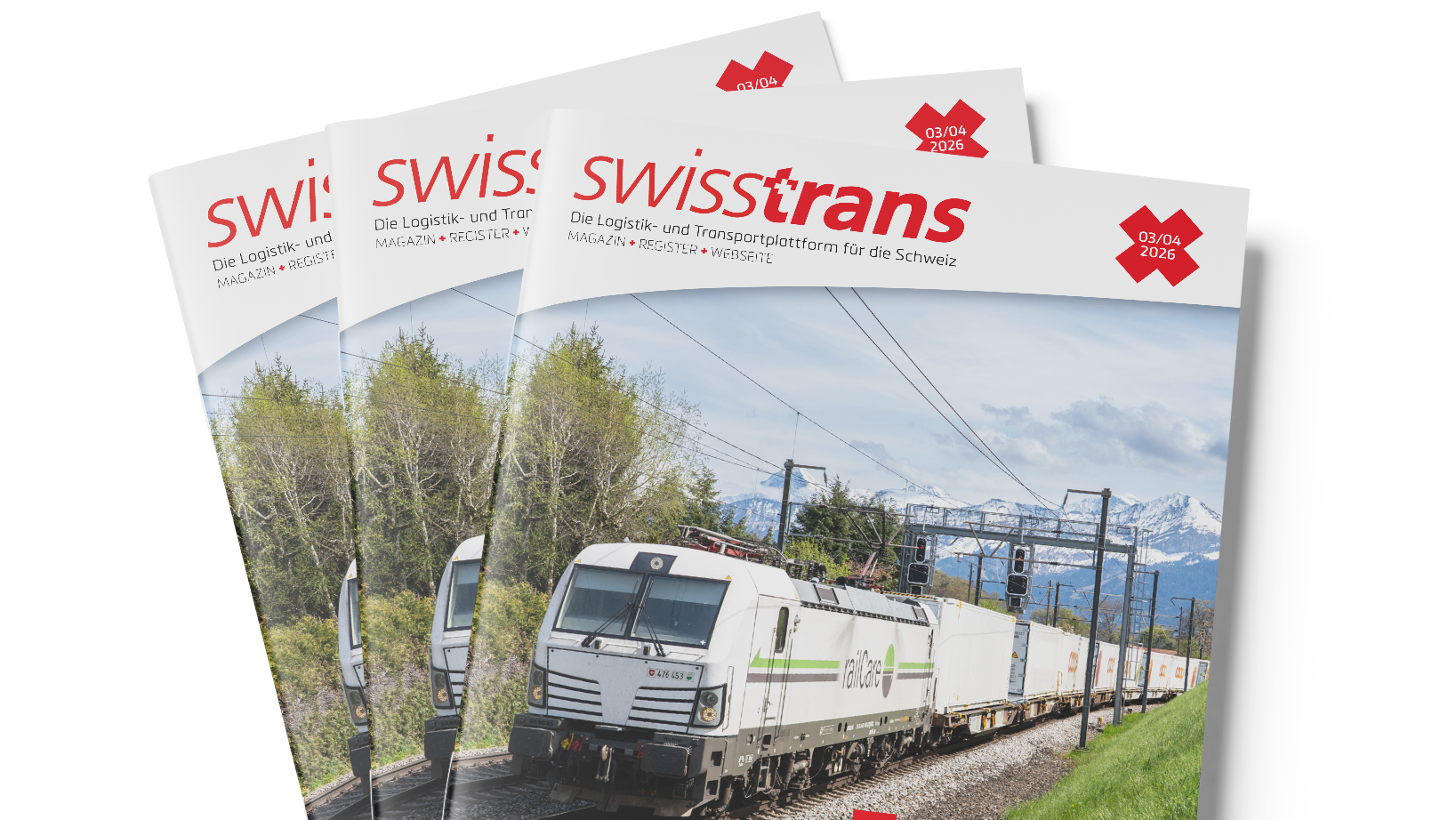
The Swisstrans Magazine Issue 03–04/2026 is online and presents rail freight transport and combined transport from the perspective of Switzerland, as well as in an international context. The content is supplemented with additional reports on the logistics and transport scene in Switzerland.
A fundamental article illustrates why intermodality only works when transport is understood as part of a holistically designed supply chain. Costs, reliability, and CO₂ are treated equally and require stable volumes, predictability, and close collaboration between shippers and logistics service providers.
Rail freight transport in Switzerland is simultaneously under pressure: The recently published activity report 2025 from RailCom highlights declining traffic performance alongside increasing passenger transport. This makes non-discriminatory market access to rail, combined transport terminals, and in the future also to the port infrastructure of the Swiss Rhine ports, particularly in the Basel area as a multimodal hub, all the more important.
Several contributions demonstrate practically how intermodal transport can become operationally more stable and transparent. Digital platforms like those from catkin connect players in combined transport, integrate capacities, and make construction sites on the rail predictable. Technologies from InnovaTrain also address a central bottleneck of combined transport: transshipment. Mobile and infrastructure-independent solutions open up new decentralized deployment possibilities beyond traditional terminals.
ECO Containertrans is highlighted as a practical example that shows how the Swiss industry remains reliably connected to the major European seaports via rail, inland shipping, and trucks despite seaport, corridor, and capacity bottlenecks – with clear responsibility across the entire transport chain.
The issue is rounded off by strategic exchanges in the Rhine corridor: The Port of Rotterdam and the Swiss Rhine ports are deepening their collaboration to jointly advance intermodal hinterland transport, sustainability, and digitalization.
The Swisstrans 03–04/2026 conveys that rail, combined transport, and intermodality do not grow through individual measures, but through integrated concepts, reliable framework conditions, and the interplay of infrastructure, digitalization, and supply chain design. An issue that shows how transport chains in Switzerland and Europe can be made more robust, sustainable, and future-proof.